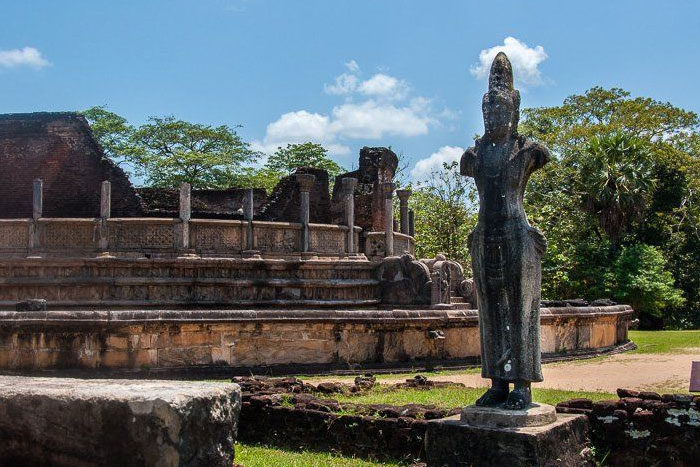
One of the highlights of the Cultural Triangle, if not the whole of Sri Lanka, is the great ruined capital of Polonnaruwa is. In its twelfth-century heyday the city represented a high point of early Sri Lanka civilisation.
Polonnaruwa has extensive and well-preserved structures that offer a fascinating glimpse of the Sri Lanka of the middle ages, including some of the island’s finest monuments. It is compact enough to be looked over fairly completely in a single (but busy) day.
Royal Palace
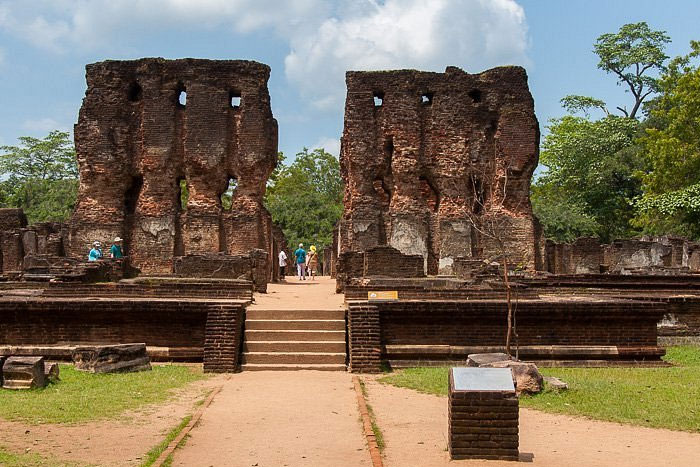
The first group of ruins you meet after entering the ground of the Ancient City is the Royal Palace Group. This group of buildings dates from the period of King Parakramabahu I (1153 – 1186). The King`s Royal Palace is a massive structure, measuring 31 m by 13 m, once including 50 rooms supported by 30 columns. Even today it is quite an impressive building, but picture it being seven floors tall with 3m thick walls, as the archaeologists claim it once was!
Today only some of the walls are left, with holes to hold floor beams for two higher levels. If the building had four more levels above these stone walls, the archaeologists speculate that they must have been made of wood. Impressive building such a big palace in those days without machines!
The Gal Vihara
The Gal Vihara, located in the ancient city of Polonnaruwa, is one of Sri Lanka’s most remarkable Buddhist monuments and a masterpiece of Sinhalese rock carving. Dating back to the 12th century during the reign of King Parakramabahu I, this sacred site features four magnificent Buddha statues carved directly into a single granite rock face.
The sculptures include a large seated Buddha, a smaller seated figure inside a carved niche, a standing Buddha believed to symbolize compassion, and a 14-meter-long reclining Buddha that represents the Buddha’s passing into Nirvana. Each statue reflects exquisite craftsmanship, capturing both serenity and spiritual depth.
Surrounded by the peaceful atmosphere of Polonnaruwa’s ancient ruins, the Gal Vihara continues to be a place of worship and meditation for devotees and visitors alike. It stands as a timeless symbol of Sri Lanka’s rich cultural heritage and the profound artistry of its ancient civilization.


Swimming Pool
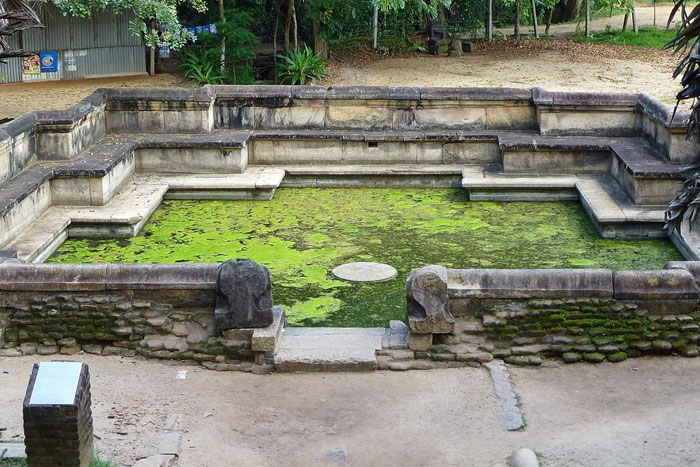
In one corner of the palace grounds is the king´s swimming pool, with crocodile-mouth spouts used to lead fresh water into the pool. Today the water is not very tempting to go swimming in, alien-green as it is!
Sacred Quadrangle
The Sacred Quadrangle is a compact group of beautiful and impressive ruins within a raised up platform bounded by a wall. This is the most concentrated collection of buildings in the whole Ancient City, and a must-see for any visitor!